Vape labelling requirements in the UK: what the pack must show
What a UK nicotine vape pack must show under the 2016 regulations: the 30% nicotine warning, ingredients, batch number, leaflet and child-resistant pack rules.

Vape labelling requirements in the UK for nicotine products come from Part 6 of the Tobacco and Related Products Regulations 2016. For a nicotine vape, each unit packet and any container pack must list the ingredients, the nicotine content and delivery per dose, the batch number and a recommendation to keep the product away from children, and it must carry the nicotine health warning on the front and back, covering 30% of each surface. A leaflet goes inside, the pack must be child-resistant and tamper-evident, and the product has to be notified to the MHRA before it can be sold.
Which law sets vape labelling requirements in the UK
The core rules are in Part 6 of The Tobacco and Related Products Regulations 2016 (SI 2016/507). Part 6 covers electronic cigarettes and refill containers, and it splits the duties into separate regulations: notification to the MHRA, product requirements, product information and labelling, and product presentation.
The regulations define an electronic cigarette as a product that can be used to consume nicotine-containing vapour through a mouthpiece, including any component such as a cartridge, a tank or the device without its cartridge or tank. A refill container is a receptacle holding nicotine-containing liquid that can be used to refill an electronic cigarette. If your product contains nicotine, Part 6 almost certainly applies to its packaging.
The MHRA is the competent authority for the notification scheme. Its guidance, E-cigarettes: regulations for consumer products, confirms that e-cigarettes and e-liquids must be notified and published by the MHRA before they can be sold, and that nicotine-containing products or their packaging must be child-resistant and tamper-evident.
This guide explains what the rules say about the pack. It is not legal advice. Check the current rules with the relevant regulator or a legal adviser for your product before you sign off artwork.
What the unit packet and container pack must show
Regulation 37 is the labelling regulation. It applies to two levels of packaging: the unit packet (the smallest individual pack sold to the consumer) and the container pack (outer packaging that holds unit packets, where one exists). The table below sets out each item and where the rule sits.
| Item | Where it goes | Rule |
|---|---|---|
| List of all ingredients, in descending order by weight | Unit packet and container pack | Reg 37(3)(a) |
| Nicotine content and delivery per dose | Unit packet and container pack | Reg 37(3)(b) |
| Batch number | Unit packet and container pack | Reg 37(3)(c) |
| Recommendation to keep the product out of reach of children | Unit packet and container pack | Reg 37(3)(d) |
| Nicotine health warning | Front and back of the unit packet and any container pack | Reg 37(4) to (6) |
| Leaflet with use, storage and safety information | Inside each unit packet | Reg 37(2) |
| Child-resistant and tamper-evident pack or product | The e-cigarette or refill container | Reg 36 |
Most brands also show their own name, the product name, the flavour, the nicotine strength in mg/ml and the fill volume in ml. Those help the buyer and the retailer, but the legal list above is the minimum the regulations set.
Batch numbers in practice
The batch number has to be on the pack, which means it must be added at the point of filling, not at the artwork stage. Leave a clear panel for a printed, stamped or labelled batch code, and make sure the surface takes ink. A gloss laminate or a soft-touch finish can smudge a stamped code, so test your coding method on a real sample before the run.
The nicotine health warning: wording, size and font
Regulation 37(4) sets the wording: “This product contains nicotine which is a highly addictive substance”. Regulation 37(5) then sets the format. The warning must:
- appear on both the front and back surfaces of the unit packet and any container pack;
- cover 30% of the area of each of those surfaces;
- be in black Helvetica bold type on a white background;
- use a font size that makes the text fill as much of the reserved area as possible;
- be centred in that area, and run parallel to the main text on the surface (regulation 37(6)).
Measuring the 30% area
Work it out from the flat dieline, panel by panel. For a front panel of 50 mm by 120 mm, the panel area is 6,000 square millimetres, so the warning box needs at least 1,800 square millimetres, for example a full-width band 50 mm wide and 36 mm tall. Do the same sum for the back panel, which may be a different size. Keep a small safety margin so that trimming or folding tolerances do not push the warning under 30%.
Why the white background matters
The rule asks for black text on a white background. On a black, kraft or metallic pack you need a printed white box for the warning, not black text straight on the substrate. On holographic or foil materials, that white box needs an opaque white underprint so it reads as true white. Ask for a proof that shows the warning panel at full size.
The leaflet inside every unit packet
Regulation 37(2) requires a leaflet in each unit packet of the electronic cigarette or refill container. It must cover:
- instructions for use and storage, including a note that the product is not recommended for use by young people and non-smokers;
- contra-indications;
- warnings for specific risk groups;
- possible adverse effects;
- addictiveness and toxicity;
- contact details of the producer (with an extra contact rule for some products supplied in Northern Ireland).
For refillable devices, regulation 37(7) adds refilling instructions with diagrams. In packaging terms, plan a box or sleeve deep enough to hold a folded leaflet without bulging, and agree the folded leaflet size before the dieline is final. A leaflet that is a few millimetres too big will crease the box and slow down packing.
Child-resistant and tamper-evident packs
Regulation 36 sets the product requirements. Among them, it says the electronic cigarette and refill container must be child-resistant and tamper-evident, protected against breakage and leakage, and refillable without leakage where refilling applies. It also limits dedicated refill containers to 10 ml, disposable devices, single-use cartridges and tanks to 2 ml, and nicotine strength to 20 mg/ml.
Regulation 36(9) explains tamper evidence: the product has one or more indicators or barriers to entry that give visible evidence, if breached or missing, that the product or its packaging has been opened. In practice that is a break-off band, a seal or a label that tears on opening. The MHRA guidance describes the requirement as applying to the products or their packaging. Whatever provides the child resistance, hold the test evidence for it, and ask your packaging supplier exactly what a closure or pack has and has not been tested to.
What the pack must not say or show
Regulation 38 controls product presentation. The unit packet and container pack must not include any element or feature that:
- promotes the product or encourages its use by giving a misleading impression of its characteristics, health effects, risks or emissions;
- suggests the product is less harmful than others, has vitalising, energising, healing, rejuvenating, natural or organic properties, or has other health or lifestyle benefits;
- refers to taste, smell or other additives (except flavourings), or to the absence of any of them;
- resembles a food or cosmetic product;
- suggests the product has better biodegradability or other environmental advantages.
Regulation 38(4) adds that packs must not suggest economic advantages through printed vouchers, discounts, free distribution or multi-buy offers. Regulation 38(5) makes clear that “elements” include text, symbols, names, trademarks and other figurative signs, so a brand name or a picture can break the rule as easily as a slogan.
For designers, this rules out sweet-shop styling, cartoon food, “eco” badges on the pack and any copy that hints at a lifestyle benefit. It also affects flavour names and imagery, so review those with the regulation open beside you.
Nicotine-free products and other rules that can apply
Part 6 is built around nicotine-containing vapour. A device that is never sold with nicotine, or a liquid with no nicotine, may sit outside Part 6, but it still has to be safe under general product safety law, and other labelling rules can apply. For example, if a liquid is classified as hazardous under GB CLP (retained Regulation (EC) No 1272/2008), the CLP labelling and packaging rules, including child-resistant fastenings and tactile warnings for some hazard classes, can apply as well.
Do not assume a product is out of scope because it is sold as nicotine-free. Confirm the position for your exact product with the relevant regulator or a legal adviser.
Changes to watch in 2025 and 2026
Two changes affect the wider vape market and are worth tracking when you plan packaging:
- Single-use vapes in England. The Environmental Protection (Single-use Vapes) (England) Regulations 2024 came into force on 1 June 2025. They make it an offence to supply, offer to supply or hold for supply a single-use vape in England. A vape has to be both refillable and rechargeable, with a coil the user can replace, to fall outside the definition.
- The Tobacco and Vapes Act 2026. Section 94 gives the Secretary of State power to make regulations on the retail packaging of vaping and nicotine products, including markings, information, appearance, materials, size, shape and how a pack opens. Other sections cover product features, flavours and retail displays.
The Act’s powers only change pack rules once regulations are made under them, and those can come in stages. Before you commit to a large print run, check legislation.gov.uk and the MHRA pages for any new packaging regulations, and keep your artwork files easy to update.
Planning artwork around the legal panels
The legal content takes up real space, so design around it from the start rather than squeezing it in at the end.
- Start from the dieline. Mark the front and back panels, calculate the 30% warning area for each and block it out before any brand artwork goes on. Our dielines page explains how we supply and check them.
- Set a type hierarchy. The warning has a fixed style. Your brand mark, product name and strength should be clear without competing with it.
- Reserve a coding panel. Keep a plain area for the batch number and test it with your coding method.
- Check the side panels. Ingredients and nicotine details often fit best on a side panel, in a type size that stays legible after printing.
- Proof at full size. Print or view a 1:1 proof, fold it, and read every legal line as a buyer would.
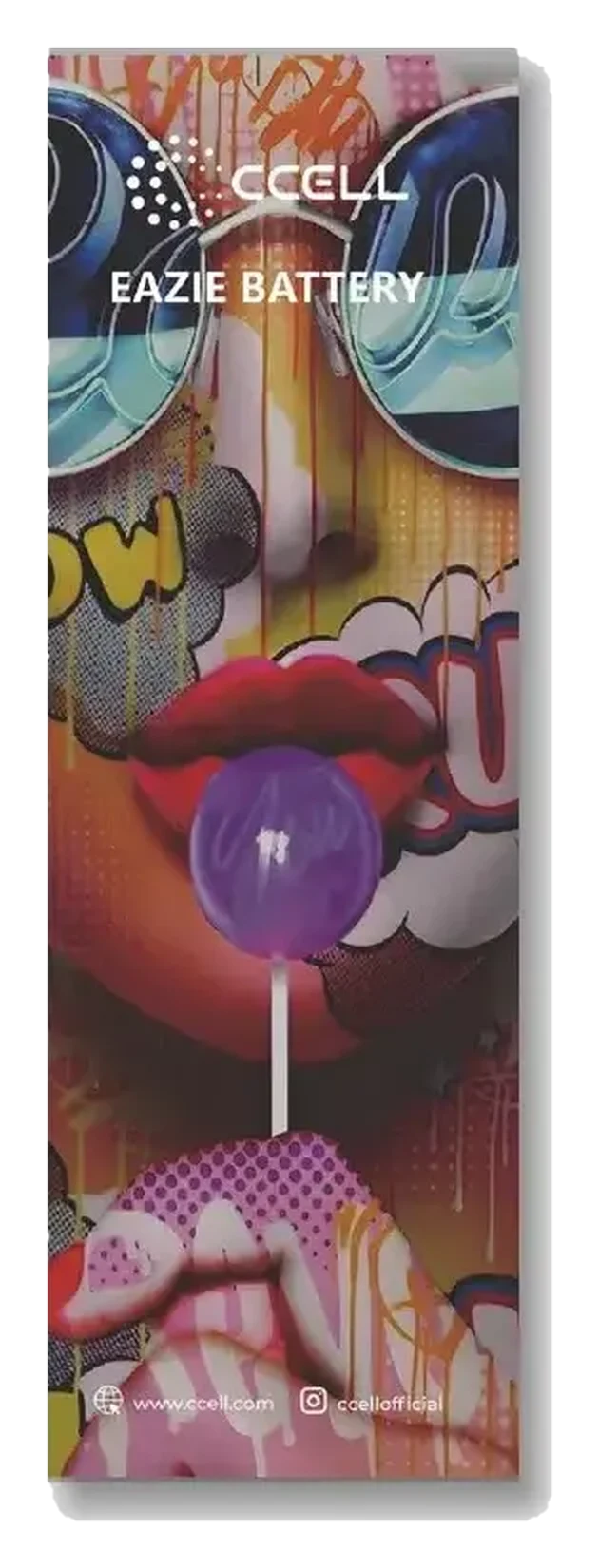
If you use stock packaging, check what is already printed on it. The CCELL boxes in our vape device boxes range carry CCELL’s own details and compliance text on the back. On the plain-front Eazie boxes, your branding goes on a sticker on the front panel of the box itself, never on the outer wrap, so you still need to confirm that the finished pack carries everything your product needs.
Getting your vape packaging ready
We make and supply vape packaging, not devices or e-liquid, so the legal responsibility for what goes inside the pack sits with you as the producer. What we can do is help you plan a pack that has room for every required element and prints cleanly. Browse the CCELL packaging range, see how a design looks folded in our 3D studio, or send us your product details through the quote form and we will come back with options.
Frequently asked questions
What warning has to go on vape packaging in the UK?
For nicotine products, regulation 37 of the Tobacco and Related Products Regulations 2016 requires the words “This product contains nicotine which is a highly addictive substance” on the front and back of the unit packet and any container pack, covering 30% of each surface, in black Helvetica bold on a white background.
Does a vape box need a batch number?
Yes. Regulation 37(3) requires the batch number on the unit packet and any container pack, alongside the ingredients list, the nicotine content and delivery per dose, and a recommendation to keep the product away from children.
Is a leaflet required inside every vape pack?
Yes, for nicotine products each unit packet must include a leaflet covering use and storage, contra-indications, warnings for specific risk groups, possible adverse effects, addictiveness and toxicity, and the producer’s contact details.
Can vape packaging say a product is eco-friendly?
Regulation 38 says the unit packet and container pack must not suggest that the product has better biodegradability or other environmental advantages. Keep recycling information factual and check the wording against the regulation before printing.
Do the rules apply to nicotine-free vapes?
Part 6 of the 2016 regulations is built around nicotine-containing products, but nicotine-free products still have to meet general product safety law and, where a liquid is classified as hazardous, CLP rules. Check your exact product with the relevant regulator or a legal adviser.
Has the Tobacco and Vapes Act changed vape packaging rules?
The Tobacco and Vapes Act 2026 gives powers to make new regulations on retail packaging, product features, flavours and displays. Pack rules change only when those regulations are made, so check legislation.gov.uk and the MHRA guidance for the current position before printing.